Friday, January 24, 2014

The Natural

There are a lot of sports movies out there, but none as great or as film noir-ish as The Natural.
The story starts out with a kid, Roy Hobbs, playing baseball with his father. Then as a young man, on a train on the way to try out for the big leagues, he meets a woman in black named Harriet Bird (played by Barbara Hershey), who winds up shooting him in a hotel, effectively ending his potential career in baseball.
The story picks up 16 years later, when an older, quieter and more mysterious Hobbs comes to play for the New York Knights. He's signed on but not wanted because of his age. The grouchy (yet ultimately endearing) manager, Pop Fisher (Wilford Brimley) doesn't let him hit for a long time; he basically spends his time warming the dugout bench.
Then, finally, during one practice, he shows what he's got. After which Roy Hobbs not only becomes part of the team, but he's the star player: Wherein he began, years earlier, as a hopeful pitcher, he's now a home run hitter.


One of the scenes I really liked was when Roy and Iris, who was his girlfriend as a kid, talk again after many years. During his successful turn as the Knight's chief slugger, he had been with someone else... a temptuous "femme fatalle" played by Kim Basinger... who, like the woman who shot him years earlier, also wears black.
But Iris, fitfully adorned in white, goes to one of his games, and they connect again, meeting at a restaurant in a very heartfelt scene providing Robert Redford and Glenn Close a genuine chemistry: like they were made for each other. Whereas he had been in a slump after spending too much time with Basinger's Memo Paris, he's now back on track and helping the Knights win.
The cinematography is really beautiful in the film. I love the lighting and how in the scene where he is playing past the railroad tracks and you can see the ferris wheel in the background, it looks so beautiful.

Another scene that really stood out for me was when Roy was going to play his last game. Iris has a note given to him: saying the boy sitting beside her is his son. This gives him the needed determination, especially after his past injury had begun to reemerge, bringing him into another slump. The note, and the presence of both Iris and their child, is what it took for Roy to be victorious again.
At the end, when he's playing baseball with his son just like he did with his dad at the beginning, is a fantastic parallel that binds the entire story together.
THE NATURAL is very symbolic, deep and engrossing, and yet there's also an uplifting, energetic quality about getting out there and showing that you still have what it takes to be great again.


Iris Gaines: You know, I believe we have two lives.
Roy Hobbs: How... what do you mean?
Iris Gaines: The life we learn with and the life we live with after that.

Wednesday, January 8, 2014

Best Picture Winners: One Flew Over the Cuckoo's Nest


Jack Nicholson has won three oscars, and each performance he plays eccentric and neurotic characters, but in One Flew Over the Cuckoo's Nest, one of the few motion pictures to capture all the top Oscar prizes, he's only acting crazy.
Set in a mental asylum in the early 1960s, somewhere in Oregon, Nicholson's Randal Patrick McMurphy has all the trimmings of a character born to be rooted for. The patients in the ward are so narcassistic it would only take a particular brand of confidence to break them from their shells and that is just what he aims to do, it just won't be easy...
The first task (and pretty much the main task through the whole film) is dealing with Nurse Ratched, played by none other than Louise Fletcher who is a star in her own right. Her gentle disposition makes her really creepy because she is so calm and mellow, masking the fact she's the ultimate control freak. While she is doing her job, the guys, with McMurphy's help, rebel against her. Some of them were afraid, but Cheswick had a fit and wanted his cigarettes. He was tired of her rules and stood up for himself. This was perhaps the first of several small yet important victories against the head nurse: An action taken by one of her usually docile patients and inspired by McMurphy.
An important scene is when McMurphy, after Cheswick's tantrum, crosses the line by breaking into the Nurses' station to get the cigarettes, partly because he just couldn't take his shouting anymore.
Also when he was trying to get everyone to raise their hand so he could watch the World Series was great and Chief raised his hand! That was awesome. He was my favorite by the way. I liked that he was acting deaf and dumb the whole time and he wasn't.


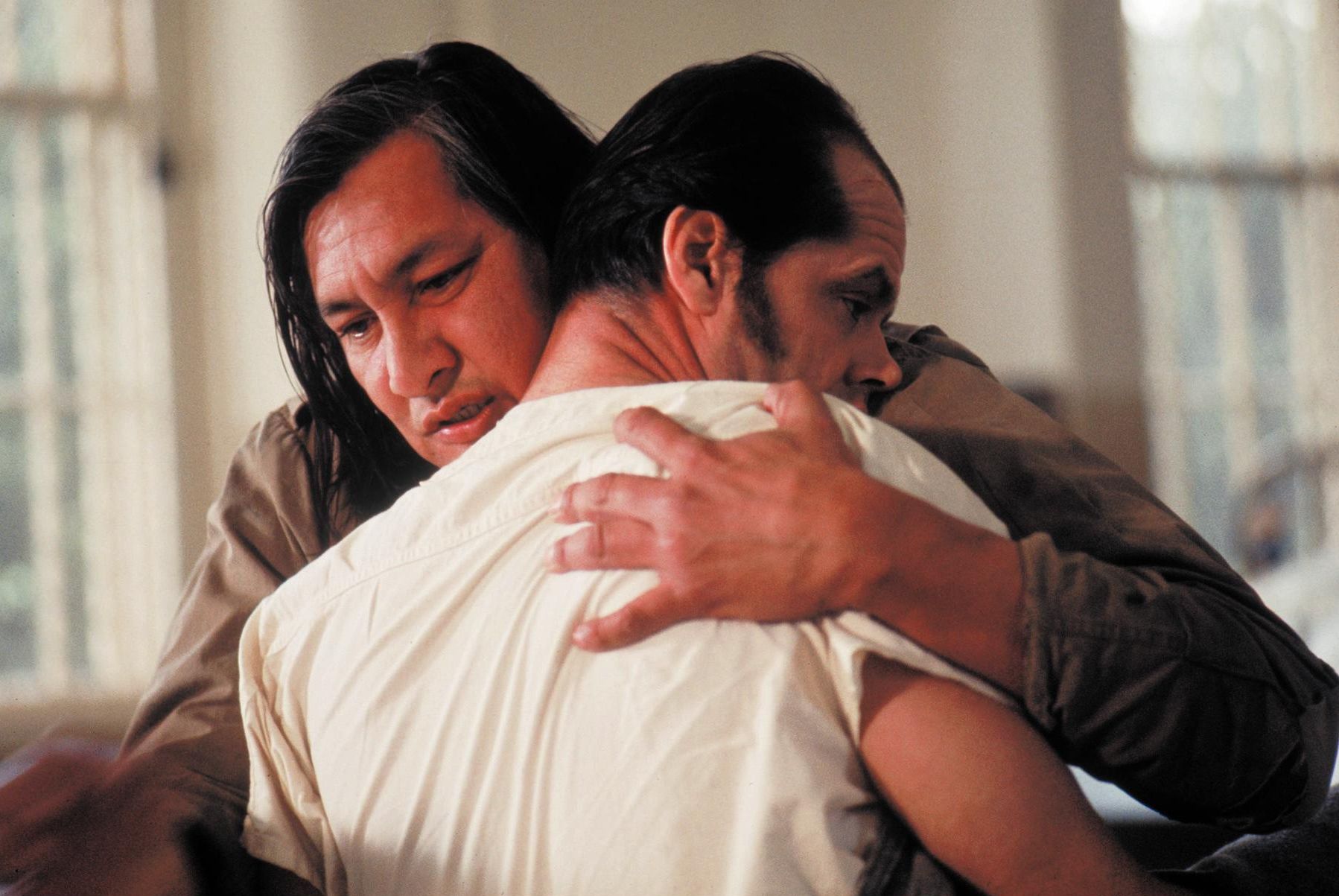
Their friendship was really nice and the fact that at the end, when Chief hugged him and said "I'm not going without you, Mac" was very emotional. And then he suffocated McMurphy with the pillow, which I didn't understand at first, but I do now.
Chief told him that he wasn't going without him, but Mac didn't really understand anyway because he had a lobotomy and his brain was fried. So Chief just killed him out of mercy. And then he took the big sink... the one that McMurphy had attempted to lift earlier on... and threw it out the window.
At this point the patients (especially Christopher Lloyd's character, Tabor) all cheered for the Chief. It was as if he was doing it for McMurphy because he wouldn't be able to anymore.
McMurphy, at least in his mind, might have been the one who flew the nest, but Chief was the one that ultimately got free.


It was really nice seeing McMurphy really get these men to stand up and realize they aren't crazy, and that they can do things like fish and play basketball.
One Flew Over the Cuckoo's Nest, based on a novel by Ken Kesey and directed by Milos Forman (who would win another best director Oscar for Amadeus in 1984) really shows how asylums were back then, and what they did to people and how truly frightening they were. It is definitely an important film and i'm glad that I was able to experience it.